How do chip I/O, top-level ports, macro pins, and block pins differ?
From PDVerse PnR Interview Handbook · pdVerse Mentor Guide
Short Answer
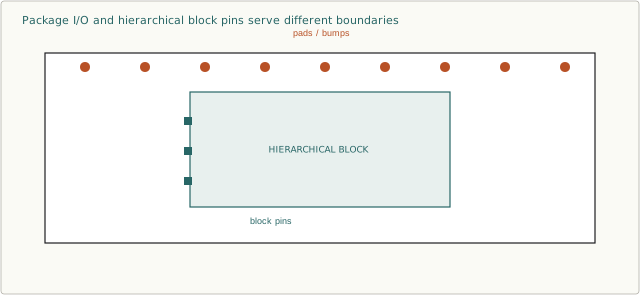
Chip I/O pads or bumps connect the die to the package; top-level terminals represent design connections; macro pins belong to fixed macros; block pins expose hierarchical interfaces.
Technical Explanation
They are connection points at different physical and logical boundaries. Package rules drive chip I/O. Dataflow and hierarchy drive block pins. Macro pin geometry is fixed by the macro view.
Formula Or Decision Rule
Decision rule: identify the boundary owner before applying placement, layer, spacing, or ordering constraints.
What To Check
• Warning sign: A block pin is treated like a package pad, or a macro pin is assumed movable. • Inspect: choose one affected region, macro, row, pin, path, or net and trace the physical cause. • Correct: Apply the constraint to the correct object class and verify the reported side, layer, and offset.
Command Checks & Actions
• report_pin_placement -format {layer side offset}: reports pin layer, side, and offset

Run only the commands needed for this question. Save the report with the floorplan version and analysis context.
Healthy, Suspicious & Hard-stop Results
• Healthy: Chip I/O pads or bumps connect the die to the package; top-level terminals represent design connections; macro pins belong to fixed macros; block pins expose hierarchical interfaces. • Suspicious: A block pin is treated like a package pad, or a macro pin is assumed movable. • Hard stop: required legality or physical feasibility is missing or unexplained. Apply the constraint to the correct object class and verify the reported side, layer, and offset.
Common Mistake
Do not hide the symptom with an arbitrary utilisation, halo, channel, blockage, pin move, or die-size change. A block pin is treated like a package pad, or a macro pin is assumed movable.
What The Interviewer Is Testing
The interviewer is testing whether you can connect “How do chip I/O, top-level ports, macro pins, and block pins differ?” to measurable physical evidence and an owned correction.
Practical Example
Symptom: A block pin is treated like a package pad, or a macro pin is assumed movable. Corrective path: Apply the constraint to the correct object class and verify the reported side, layer, and offset.
Continue practising