What are boundary, end-cap, and corner cells?
From PDVerse PnR Interview Handbook · pdVerse Mentor Guide
Short Answer
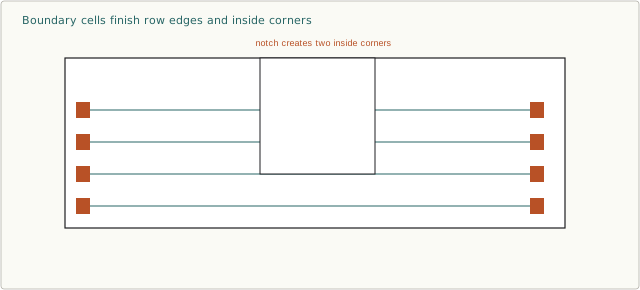
Core boundary cells protect and complete standard-cell row edges; inside/outside corner cells handle core or voltage-area corners; I/O-ring corner cells belong to the pad ring. They are different library functions.
Technical Explanation
All three live near boundaries, but they close different physical structures. Library rules, row orientation, voltage areas, and I/O-guide context decide the correct cell. They are not substitutes for tap, filler, decap, or well-tie cells.
Formula Or Decision Rule
Decision rule: use the library-specific cell family for the boundary it was designed to complete.
What To Check
• Warning sign: A corner is empty, uses the wrong orientation, or mixes core and I/O corner concepts. • Inspect: choose one affected region, macro, row, pin, path, or net and trace the physical cause. • Correct: Set and report the correct rules, insert in the right context, then run the applicable checks.
Command Checks & Actions
• set_boundary_cell_rules -left_boundary_cell <lib_cell> -right_boundary_cell <lib_cell>: defines library-specific boundary-cell choices
• report_boundary_cell_rules: reports the active boundary-cell rules
• compile_boundary_cells: inserts boundary cells using the active rules; this command is deprecated in the referenced release, so verify the project-approved targeted replacement
• create_io_corner_cell -reference_cell <io_corner_lib_cell> <two_io_guides>: inserts an I/O-ring corner cell between two perpendicular I/O guides

Run only the commands needed for this question. Save the report with the floorplan version and analysis context.
Healthy, Suspicious & Hard-stop Results
• Healthy: Core boundary cells protect and complete standard-cell row edges; inside/outside corner cells handle core or voltage-area corners; I/O-ring corner cells belong to the pad ring. They are different library functions. • Suspicious: A corner is empty, uses the wrong orientation, or mixes core and I/O corner concepts. • Hard stop: required legality or physical feasibility is missing or unexplained. Set and report the correct rules, insert in the right context, then run the applicable checks.
Common Mistake
Do not hide the symptom with an arbitrary utilisation, halo, channel, blockage, pin move, or die-size change. A corner is empty, uses the wrong orientation, or mixes core and I/O corner concepts.
What The Interviewer Is Testing
The interviewer is testing whether you can connect “What are boundary, end-cap, and corner cells?” to measurable physical evidence and an owned correction.
Practical Example
Symptom: A corner is empty, uses the wrong orientation, or mixes core and I/O corner concepts. Corrective path: Set and report the correct rules, insert in the right context, then run the applicable checks.
Continue practising