What are PVT corners, modes, and MMMC scenarios?
From PDVerse PnR Interview Handbook · pdVerse Mentor Guide
Short Answer
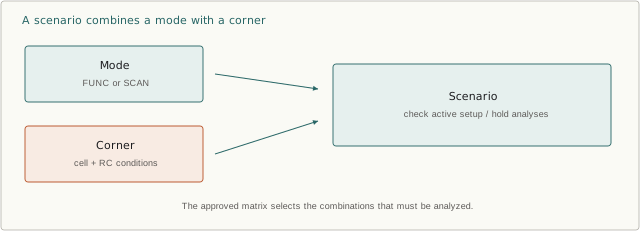
A mode describes how the design operates; a corner describes analysis conditions; an ICC2 scenario combines one mode and one corner. MMMC checks the design across multiple modes and corners instead of trusting one favorable case.
Technical Explanation
Process, voltage, and temperature affect cell behavior. Interconnect conditions also affect delay, so a corner setup needs the intended cell models and parasitic assignments, plus any required variation methodology. A functional mode and a scan-shift mode can use different clocks, case analysis, and exceptions even if they share some operating conditions. Not every mathematical combination must be active. The approved analysis matrix determines the required scenarios and which analysis types are enabled in each. A scenario's existence alone is insufficient: a required setup or hold analysis can be disabled. Audit both scenario definitions and status, along with library and RC coverage. Avoid oversimplified claims such as 'hot is always slow' or 'RCmax is always the worst setup corner.' Temperature inversion, path composition, and clock/data interactions can make the limiting case less obvious. Use characterized libraries and the approved signoff combinations. The interview goal is to explain the separation of concepts and how to verify coverage, rather than recite a universal corner nickname.
Common Mistake
Treating a mode as just a temperature, or creating many scenarios without checking which ones actually participate in optimization.
Follow-up Question & Model Response
Why can timing look clean in one scenario and fail in another? Different edge relationships, models, loads, exceptions, and early/late behavior change the analyzed problem.
Practical Example
FUNC_SLOW might pair functional constraints with one slow operating corner, while SCAN_FAST pairs shift constraints with another corner. Their clocks and active checks can differ; neither can replace the other merely because both produce a timing report.
Continue practising