Thousands of registers show no_clock after SDC load. What do you do?
From PDVerse PnR Interview Handbook · pdVerse Mentor Guide
Short Answer
Treat this as a hard stop and test competing causes: wrong current mode, empty clock source selector, broken generated/gated path, or mismatched hierarchy.
Technical Explanation
Treat this as a readiness check. It should produce named objects and a result that another engineer can repeat from the same handoff.
What To Check
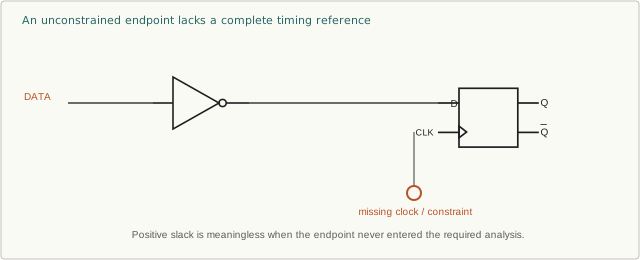
• Warning sign: check_timing reports a large no_clock population although read_sdc completed. • Inspect: Keep at least two possible causes open, then use one named object and the active mode or scenario to separate them. • Correct: Correlate affected hierarchy with report_clocks and selector results, then return the defect to the SDC or netlist owner and rerun.
Command Checks & Actions
• check_timing -include {no_clock}: finds missing or inconsistent timing setup
• report_clocks: shows clock definitions and relationships
• get_pins -hierarchical <clock_pin_pattern>: selects instance pins

Run the commands in order. Each line answers a separate part of the check.
Healthy, Suspicious & Hard-stop Results
• Expected: Treat this as a hard stop and test competing causes: wrong current mode, empty clock source selector, broken generated/gated path, or mismatched hierarchy. • Investigate: check_timing reports a large no_clock population although read_sdc completed. • Stop before floorplanning when required logic or timing coverage is missing or unexplained. Correlate affected hierarchy with report_clocks and selector results, then return the defect to the SDC or netlist owner and rerun.
Common Mistake
Do not assume the check passed just because ICC2 continued: check_timing reports a large no_clock population although read_sdc completed. Fix or narrowly justify the named objects, then rerun the same command.
What The Interviewer Is Testing
Be ready to explain why this matters before floorplanning: check_timing reports a large no_clock population although read_sdc completed.
Follow-up Question & Model Response
Model response: “I would save the report, inspect one affected object in the correct block and scenario, and make or request this correction: Correlate affected hierarchy with report_clocks and selector results, then return the defect to the SDC or netlist owner and rerun. Then I would reopen the clean checkpoint and rerun the same evidence.”
Practical Example
Symptom: check_timing reports a large no_clock population although read_sdc completed. Corrective path: Correlate affected hierarchy with report_clocks and selector results, then return the defect to the SDC or netlist owner and rerun.
Continue practising