How do die, core, and core offset differ?
From PDVerse PnR Interview Handbook · pdVerse Mentor Guide
Short Answer
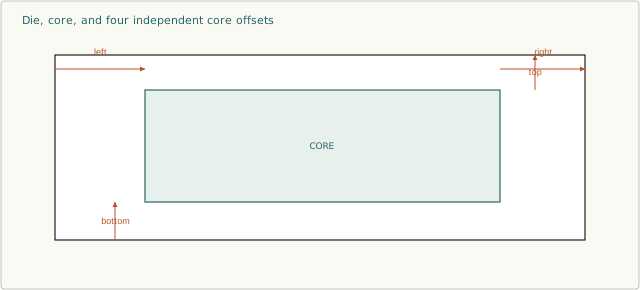
The die is the outer design boundary; the core is the region used for standard-cell rows and most implementation objects. Core offsets are the distances from die sides to core sides.
Technical Explanation
Picture a plot of land and a buildable region inside it. The margin between them is not automatically equal on all sides. Offsets may reserve space for I/O structures, power rings, seal-ring needs, or access. Their order and meaning must follow the chosen boundary and tool syntax.
Formula Or Decision Rule
Die width = left offset + core width + right offset; die height = bottom offset + core height + top offset.
What To Check
• Warning sign: The core touches an unintended die side or leaves too little room for required structures. • Inspect: choose one affected region, macro, row, pin, path, or net and trace the physical cause. • Correct: Correct the boundary or offsets from package and power-planning requirements, then regenerate and report the floorplan.
Command Checks & Actions
• initialize_floorplan -control_type core -core_offset {<side_1> <side_2> <side_3> <side_4>}: creates the initial die, core, rows or site array, and tracks from declared controls
• report_design -floorplan: reports the floorplan state understood by the tool

Run only the commands needed for this question. Save the report with the floorplan version and analysis context.
Healthy, Suspicious & Hard-stop Results
• Healthy: The die is the outer design boundary; the core is the region used for standard-cell rows and most implementation objects. Core offsets are the distances from die sides to core sides. • Suspicious: The core touches an unintended die side or leaves too little room for required structures. • Hard stop: required legality or physical feasibility is missing or unexplained. Correct the boundary or offsets from package and power-planning requirements, then regenerate and report the floorplan.
Common Mistake
Do not hide the symptom with an arbitrary utilisation, halo, channel, blockage, pin move, or die-size change. The core touches an unintended die side or leaves too little room for required structures.
What The Interviewer Is Testing
The interviewer is testing whether you can connect “How do die, core, and core offset differ?” to measurable physical evidence and an owned correction.
Practical Example
Symptom: The core touches an unintended die side or leaves too little room for required structures. Corrective path: Correct the boundary or offsets from package and power-planning requirements, then regenerate and report the floorplan.
Continue practising