How do sites, rows, and routing tracks differ?
From PDVerse PnR Interview Handbook · pdVerse Mentor Guide
Short Answer
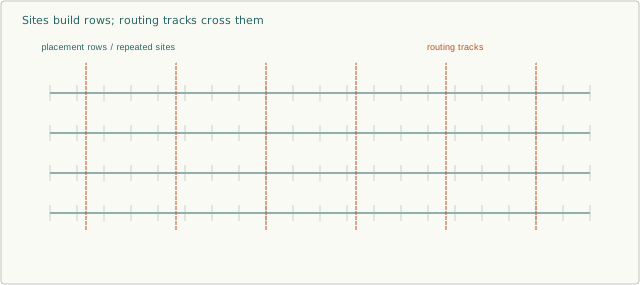
A site defines legal placement increments, a row repeats sites for standard cells, and a routing track defines candidate wire centre lines. A row is not a track.
Technical Explanation
Sites answer “where may a cell origin land?” Tracks answer “where may a wire centre run?” Rows depend on library site and rail requirements. Tracks depend on technology-layer pitch, offset, direction, and width.
Formula Or Decision Rule
Decision rule: cell origins must satisfy the site/row system while pins and wires need legal access to routing tracks.
What To Check
• Warning sign: Rows exist but use the wrong site, or pins touch the boundary without usable tracks. • Inspect: choose one affected region, macro, row, pin, path, or net and trace the physical cause. • Correct: Correct the row/site or track definition at its source and rerun floorplan and pin checks.
Command Checks & Actions
• create_site_row -name <row> -site <site> -origin {<x> <y>} -site_count <count>: creates one named row from a site and origin
• create_track -layer <layer> -space <pitch> -coord <offset> -dir <X_or_Y>: creates a routing-track pattern

Run only the commands needed for this question. Save the report with the floorplan version and analysis context.
Healthy, Suspicious & Hard-stop Results
• Healthy: A site defines legal placement increments, a row repeats sites for standard cells, and a routing track defines candidate wire centre lines. A row is not a track. • Suspicious: Rows exist but use the wrong site, or pins touch the boundary without usable tracks. • Hard stop: required legality or physical feasibility is missing or unexplained. Correct the row/site or track definition at its source and rerun floorplan and pin checks.
Common Mistake
Do not hide the symptom with an arbitrary utilisation, halo, channel, blockage, pin move, or die-size change. Rows exist but use the wrong site, or pins touch the boundary without usable tracks.
What The Interviewer Is Testing
The interviewer is testing whether you can connect “How do sites, rows, and routing tracks differ?” to measurable physical evidence and an owned correction.
Practical Example
Symptom: Rows exist but use the wrong site, or pins touch the boundary without usable tracks. Corrective path: Correct the row/site or track definition at its source and rerun floorplan and pin checks.
Continue practising