How can a placement be legal on one grid but fail another grid or pin access?
From PDVerse PnR Interview Handbook · pdVerse Mentor Guide
Short Answer
Legality is the intersection of applicable rules, not a single snapped coordinate. A cell or macro can satisfy site placement while failing a FinFET boundary rule, or satisfy both but leave no legal routing access to a pin.
Technical Explanation
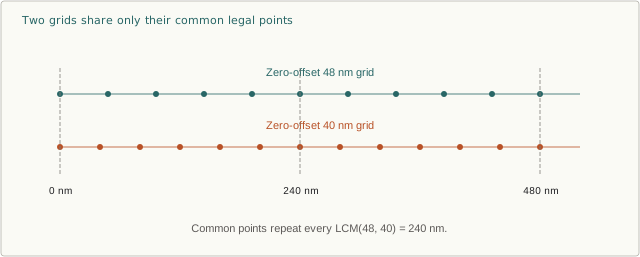
Begin with arithmetic: two regular grids share legal points only where their pitch and offset relationships permit them. In integer nanometers, the zero-offset grids with 48 nm and 40 nm pitches meet every 240 nm, their least common multiple. Different offsets change the common solutions and can eliminate them. Do this calculation only for grids that actually constrain the same coordinate or object feature. Then check geometry. A macro's origin, far edge, and pin positions are different coordinates. A legal origin combined with an incompatible width can put the far edge off-grid. A narrow pin might miss the available tracks or fail via-enclosure rules even though the macro boundary is legal. Nearby routing obstructions and power shapes can remove otherwise valid access points. Use the reports to distinguish placement legalization, FinFET-grid checking, and pin-access problems. Verify the library abstract and technology before adjusting macro positions. Check all affected interfaces after any move, not just the pin that triggered the debug session. For a real floorplan, use the implementation tool's legalizer and routing checks rather than treating a least-common-multiple calculation as a complete solution.
Common Mistake
Moving a macro to solve one pin-access problem without rechecking its boundary grids, orientation, power connections, and neighboring channels.
Follow-up Question & Model Response
What if two required grids have no common legal point? Investigate incompatible inputs or an incorrect assumed rule; do not force an illegal compromise coordinate.
Practical Example
x = 240 nm belongs to both zero-offset grids in the teaching example, while x = 96 nm belongs only to the 48 nm grid. If the second grid is shifted by 4 nm, no common point exists because gcd(48, 40) = 8 does not divide 4.
Continue practising