What are a placement site, a standard-cell row, and cell height?
From PDVerse PnR Interview Handbook · pdVerse Mentor Guide
Short Answer
A placement site is a reusable unit of legal placement geometry. A row arranges sites across the floorplan, and a standard cell occupies a compatible number of sites while respecting row height, orientation, and library rules.
Technical Explanation
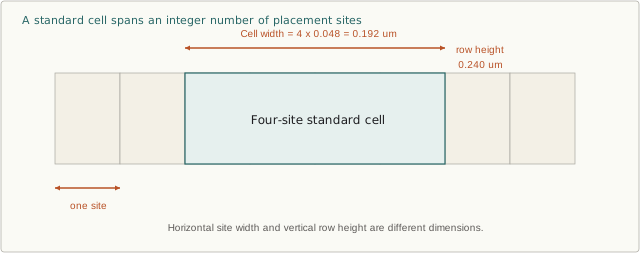
For a simple single-height library, cells share a row-compatible height but have different widths. If a site is 0.048 um wide, a cell that occupies four sites is 0.192 um wide. The width quantization lets the placer arrange cell instances on a regular legal grid. Multi-height cells and mixed-height libraries require additional compatibility and legalization rules. The physical cell boundary is not the same as transistor width. A cell contains devices, internal connections, pins, and power access. Its dimensions are library design choices constrained by technology. A nominal track-height label such as a particular number of tracks is also a library convention tied to a specified grid; do not infer every physical dimension from that name alone. Rows also carry orientation and placement-site information. Alternating orientations can support power-rail alignment where the library allows it, but a legal mirroring operation must come from the cell/site symmetry and power architecture. Reporting a row's size does not prove a particular cell is legal in it. Verify the cell's site association, height, permitted orientation, and any special constraints.
Common Mistake
Confusing placement-site width with metal routing pitch merely because their numeric values happen to match in one example.
Follow-up Question & Model Response
Why can a cell fail legalization even when it fits inside the core? It can violate site alignment, row height, orientation, overlap, region, or power-domain requirements.
Practical Example
A 0.192 um-wide cell fits four 0.048 um site steps. A placement origin at 0.096 um is two steps from a zero-offset row origin; an origin at 0.100 um is not. This is a teaching grid, not a universal library dimension.
Continue practising