Are VCD or SAIF files mandatory inputs to place and route?
From PDVerse PnR Interview Handbook · pdVerse Mentor Guide
Short Answer
Switching-activity files are conditional inputs. They improve activity-dependent power estimation and optimization, but are not universally required just to import and place a design.
Technical Explanation
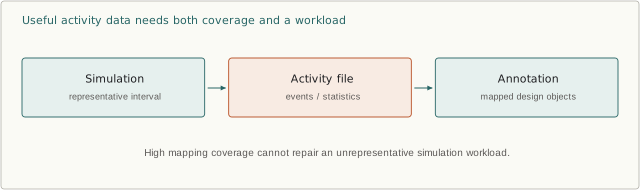
Dynamic power depends on how often nodes switch, their capacitance, supply voltage, and frequency. VCD records signal value changes over time; SAIF summarizes activity over an interval. The tool must map this activity onto the implemented design. Hierarchy changes, synthesis transformations, and naming differences can prevent annotation, leaving some logic on default assumptions. The workload matters as much as file coverage. A simulation that mostly holds reset low or never exercises a datapath can produce unrealistically low activity even if every signal maps. Choose representative operating modes, active intervals, clocks, and power states. Keep leakage and dynamic power conceptually separate; a low-toggle design can still consume leakage power. Early power estimation may use assumed or propagated activity when representative simulation data is unavailable. State those assumptions and revisit them when better activity exists. The required handoff depends on whether the flow targets power-driven placement, power analysis, or later rail analysis. For this chapter, treat activity as a targeted addition to the baseline inputs rather than an unconditional checkbox.
Common Mistake
Claiming that a VCD automatically guarantees accurate power, or reporting annotation percentage without checking the simulation interval.
Follow-up Question & Model Response
What would you inspect when power drops sharply after a netlist change? Check activity mapping and defaults before concluding that the implementation improved.
Practical Example
A multiplier exercised once during a long idle simulation appears quiet in an averaged activity summary. That summary is unsuitable for estimating the power of continuous multiply operations without explaining the workload difference.
Continue practising