What should drive initial macro placement?
From PDVerse PnR Interview Handbook · pdVerse Mentor Guide
Short Answer
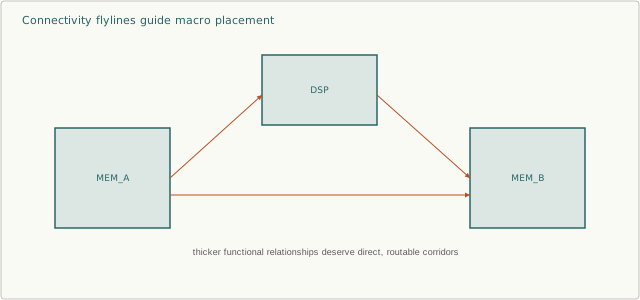
Connectivity, dataflow, timing criticality, I/O affinity, bus sharing, clock/reset sources, power domains, pin sides, and macro dimensions should drive placement.
Technical Explanation
Place communicating objects so wires have direct, legal corridors rather than drawing an attractive pattern first. Edge-biased, grouped, arrayed, channelled, abutted, and freeform strategies are choices to test, not universal rules.
Formula Or Decision Rule
Decision rule: every macro location should have a named functional reason and measurable physical consequence.
What To Check
• Warning sign: Flylines cross the core, facing pins crowd a narrow channel, or critical paths detour around macros. • Inspect: choose one affected region, macro, row, pin, path, or net and trace the physical cause. • Correct: Move or orient macros to reduce the diagnosed conflict, then repeat congestion, pin-access, and timing estimates.
Command Checks & Actions
• create_placement -floorplan -timing_driven -congestion: runs early floorplan placement when -floorplan is used
• report_design -floorplan: reports the floorplan state understood by the tool

Run only the commands needed for this question. Save the report with the floorplan version and analysis context.
Healthy, Suspicious & Hard-stop Results
• Healthy: Connectivity, dataflow, timing criticality, I/O affinity, bus sharing, clock/reset sources, power domains, pin sides, and macro dimensions should drive placement. • Suspicious: Flylines cross the core, facing pins crowd a narrow channel, or critical paths detour around macros. • Hard stop: required legality or physical feasibility is missing or unexplained. Move or orient macros to reduce the diagnosed conflict, then repeat congestion, pin-access, and timing estimates.
Common Mistake
Do not hide the symptom with an arbitrary utilisation, halo, channel, blockage, pin move, or die-size change. Flylines cross the core, facing pins crowd a narrow channel, or critical paths detour around macros.
What The Interviewer Is Testing
The interviewer is testing whether you can connect “What should drive initial macro placement?” to measurable physical evidence and an owned correction.
Practical Example
Symptom: Flylines cross the core, facing pins crowd a narrow channel, or critical paths detour around macros. Corrective path: Move or orient macros to reduce the diagnosed conflict, then repeat congestion, pin-access, and timing estimates.
Continue practising