What does UPF contain, and why is it separate from the netlist?
From PDVerse PnR Interview Handbook · pdVerse Mentor Guide
Short Answer
UPF describes power intent: which logic belongs to power domains, how supplies and states are modeled, and what protection or state-preservation strategies are required. Logical connectivity alone cannot fully express power-state behavior.
Technical Explanation
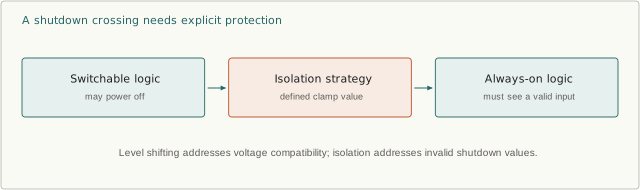
A power-gated block may shut off while neighboring logic remains on. Its outputs may then be invalid, so the receiving logic can need isolation. A crossing between different voltages may need level shifting. Registers that must preserve state through shutdown may need retention. Which cells are inserted and where they are placed depends on the power architecture, library support, and implementation methodology. UPF can describe domains, supply relationships, power states, and relevant isolation, level-shifter, retention, and switch strategies. Physical voltage areas and the power grid must agree with this intent, but they are not simply synonyms for a logical power domain. Connecting a net named VDD in a netlist does not define a complete shutdown sequence or isolation policy. The supplied ICC2 implementation flow reads UPF, resolves and checks consistency, commits the intent, and then continues with implementation. Name mapping can be important when synthesis has changed hierarchy. Verify that strategies bind to the intended objects and that power/ground conflicts are resolved. A file that loads with wrong scope can describe a different design than intended.
Common Mistake
Assuming isolation and level shifting are interchangeable, or inserting cells without checking the receiving supply and power states.
Follow-up Question & Model Response
Can a single-voltage design need UPF? Yes, for example when power gating or retention is modeled, even if active domains share a nominal voltage.
Practical Example
If a switchable accelerator drives an always-on controller, isolation may hold the interface at a defined value during shutdown. Level shifting addresses voltage compatibility; it does not automatically provide the required shutdown clamp.
Continue practising