Why is FinFET transistor width quantized by fin count?
From PDVerse PnR Interview Handbook · pdVerse Mentor Guide
Short Answer
In a conventional FinFET device family, adding parallel fins increases effective channel width in discrete increments. The designer cannot choose an arbitrary continuous width in the same way as a simple planar-width model might suggest.
Technical Explanation
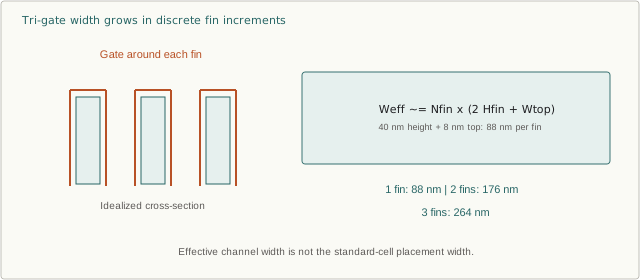
For an idealized rectangular tri-gate fin, a useful teaching approximation is effective width per fin = 2 times fin height + fin top width. The gate controls the two sidewalls and the top surface. Multiplying by the number of parallel fins gives a first-order effective width estimate. Real device models account for more detailed geometry and electrostatics, so this equation is an explanation of quantization, not a replacement for characterization. Fin count, cell drive-strength names, and standard-cell footprint are related but not identical. A library can change device sizing, parallel structures, topology, or internal wiring to provide a stronger cell. A suffix such as X2 should not be interpreted as exactly twice the fin count, twice the physical width, or half the delay. The timing model and physical view describe the actual implementation choice. At the PNR level, optimization selects approved library cells. It does not generally edit the fin count inside a characterized cell. Resizing must preserve the intended function and obey allowed cell-use, site, height, and power requirements. This is why libraries offer a discrete menu of implementations rather than every possible analog device dimension.
Common Mistake
Treating this effective electrical width as the standard cell's horizontal placement width.
Follow-up Question & Model Response
Does twice the fin count guarantee twice the circuit speed? No. Load, internal parasitics, topology, voltage, and other effects determine the resulting delay.
Practical Example
If the illustrative fin height is 40 nm and top width is 8 nm, one fin gives approximately 88 nm of effective width. Two fins give 176 nm and three give 264 nm. A desired 220 nm is not an integer-fin option in this simplified family.
Continue practising