What is the difference between LEF and DEF?
From PDVerse PnR Interview Handbook · pdVerse Mentor Guide
Short Answer
LEF describes reusable technology and cell physical abstractions; DEF describes the physical state of a particular design. One defines the building blocks and rules, while the other records how instances are arranged in a design.
Technical Explanation
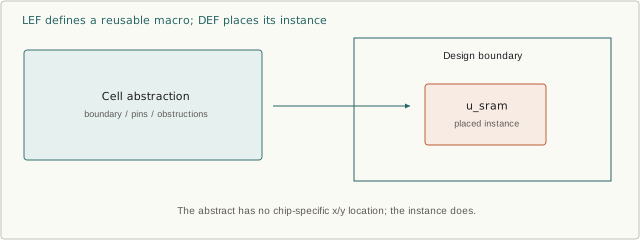
Technology LEF can describe layers, vias, and placement sites. Cell LEF typically describes a cell or macro boundary, its pin geometry, and routing obstructions. A cell's LEF does not list every placement of that cell in your chip. DEF can include the die area, rows, tracks, instance locations and orientations, ports, blockages, and routing-related information. Its exact contents depend on the stage and export settings. An initial floorplan DEF can therefore be useful without containing detailed signal routes. Conversely, a routed DEF can contain much more information than is needed for a floorplan handoff. Although DEF can carry netlist-related data, the ICC2 flow in the supplied guide imports the structural Verilog and then annotates floorplan data. Do not assume reading a DEF automatically reconstructs every required logical connection. In ICC2, implementation commonly consumes prepared NDM reference libraries. Library preparation can read LEF in the library manager; ICC2 also supports a configured flow that invokes the library manager automatically to assemble cell libraries from source data. Thus, LEF remains a common source of physical abstractions, but it should not be confused with the assembled implementation database.
Common Mistake
Reversing the two formats, or assuming a cell abstract contains a complete transistor-level layout.
Follow-up Question & Model Response
Why must names and units agree between them? Otherwise placements, pins, sites, or layers may not map to the intended objects.
Practical Example
A memory abstract says the macro is 100 by 200 micrometers and exposes pins along one edge. The design's DEF says that instance u_sram is placed at a particular coordinate and orientation. These statements answer different questions.
Continue practising