What is the difference between wire width, spacing, and pitch?
From PDVerse PnR Interview Handbook · pdVerse Mentor Guide
Short Answer
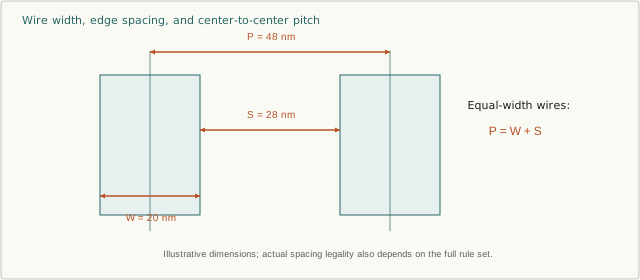
Width is the thickness of a wire measured across it. Spacing is the edge-to-edge gap between neighboring shapes. Pitch is the center-to-center distance between repeating features, such as parallel routing tracks.
Technical Explanation
For two equal-width parallel wires centered on adjacent equally spaced tracks, pitch equals width plus spacing. If each wire is 0.020 um wide and their centers are 0.048 um apart, the edge gap is 0.028 um. The diagram measures width across one shape, spacing between its edges and the next shape, and pitch between centerlines. For unequal widths, the gap is pitch minus half the first width minus half the second width. This is a geometry relationship, not a complete routing-rule checker. Actual spacing requirements may depend on width, parallel run length, line ends, masks, neighboring shapes, via enclosures, and other technology rules. A correct arithmetic result can still fail DRC. Keep routing-track pitch distinct from the pitch of shapes that actually get routed. A wide wire can occupy more than one routing resource, and some tracks may be reserved or unusable. Preferred direction, default width, and minimum spacing are also different attributes. Reading a single default pitch does not tell you the capacity available around a macro or a power strap.
Common Mistake
Calling the empty gap pitch, or treating pitch = width + spacing as universally valid for unequal-width wires.
Follow-up Question & Model Response
Does doubling wire width automatically double routing capacity? No. It consumes more space and may trigger larger spacing rules, even if resistance is reduced.
Practical Example
At 0.060 um center spacing, a 0.020 um wire beside a 0.040 um wire leaves 0.030 um between edges: 0.060 - 0.010 - 0.020. It would be incorrect to subtract only one of the widths.
Continue practising