What information does a Liberty timing library provide?
From PDVerse PnR Interview Handbook · pdVerse Mentor Guide
Short Answer
A Liberty library describes how cells behave electrically and logically under characterized conditions. It supplies information for timing, power analysis, and legal cell selection; it is not a placement drawing.
Technical Explanation
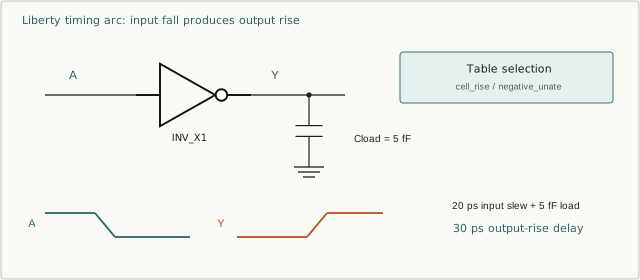
Typical content includes cell and pin names, pin directions, Boolean functions, input pin capacitance, timing arcs, output transition behavior, and electrical limits. Sequential cells also need constraints such as setup and hold, and applicable recovery/removal or pulse-width checks. Delay models often depend on input transition and output load. More advanced model formats represent behavior with richer waveform information, so not every library is just a small two-dimensional table. Characterization is tied to operating conditions and the library's model conventions. A slow-corner model and a fast-corner model can describe the same physical cell differently. Power content can include leakage and internal power information; accurate dynamic-power results additionally depend on activity, voltage, capacitance, and the analysis setup. In a Synopsys flow, textual .lib data may be compiled or incorporated into prepared library databases. Ask what the delivered NDM actually contains and how timing views are associated. The important checks are cell coverage, matching pins and functions, units, operating conditions, and compatibility with the physical views. Merely finding a .lib or .db file is not evidence that the selected scenario uses it.
Common Mistake
Saying Liberty contains final wire routes or that a single nominal delay is valid for every load and slew.
Follow-up Question & Model Response
Can one physical cell have several timing views? Yes; the same layout can be characterized for multiple process, voltage, and temperature conditions.
Practical Example
An inverter may be quick when it drives one nearby input and slower when it drives many loads. The timing model helps the tool evaluate that difference; its physical view tells the placer how much space the inverter occupies.
Continue practising