Why check libraries and units before reading timing numbers?
From PDVerse PnR Interview Handbook · pdVerse Mentor Guide
Short Answer
Library identity and user units determine how cell behaviour and numeric constraint values are interpreted.
Technical Explanation
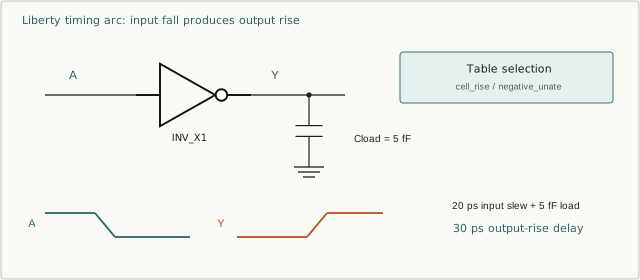
A library gives a cell its meaning, while units give every number its scale. You need both before a delay, load, or slew can be trusted.
What To Check
• Warning sign: A delay or capacitance is plausible but scaled incorrectly, or a same-named cell resolves from the wrong library. • Inspect: Start with one named object in the report and trace it to the netlist, library, or SDC statement that created it. • Correct: Load the approved compatible libraries, correct the unit boundary, relink if required, and re-read representative values.
Command Checks & Actions
• report_ref_libs: shows the reference libraries used for linking
• report_user_units: shows the units ICC2 uses when reading and printing values

Run the commands in order. Each line answers a separate part of the check.
Healthy, Suspicious & Hard-stop Results
• Expected: Library identity and user units determine how cell behaviour and numeric constraint values are interpreted. • Investigate: A delay or capacitance is plausible but scaled incorrectly, or a same-named cell resolves from the wrong library. • Stop before floorplanning when required logic or timing coverage is missing or unexplained. Load the approved compatible libraries, correct the unit boundary, relink if required, and re-read representative values.
Common Mistake
Do not assume the check passed just because ICC2 continued: A delay or capacitance is plausible but scaled incorrectly, or a same-named cell resolves from the wrong library. Fix or narrowly justify the named objects, then rerun the same command.
What The Interviewer Is Testing
Be ready to explain why this matters before floorplanning: A delay or capacitance is plausible but scaled incorrectly, or a same-named cell resolves from the wrong library.
Practical Example
Symptom: A delay or capacitance is plausible but scaled incorrectly, or a same-named cell resolves from the wrong library. Corrective path: Load the approved compatible libraries, correct the unit boundary, relink if required, and re-read representative values.
Continue practising