Which units are used in physical design, timing, and power?
From PDVerse PnR Interview Handbook · pdVerse Mentor Guide
Short Answer
A number has engineering meaning only when its unit is known. Physical design combines distance, time, capacitance, resistance, voltage, current, and power, and the units can differ between files and reports.
Technical Explanation
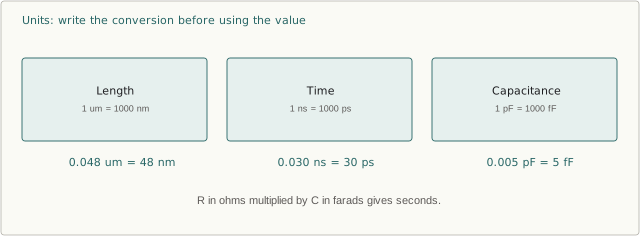
Physical dimensions are commonly expressed in micrometers, abbreviated um in plain text, or nanometers, abbreviated nm. One micrometer equals 1000 nanometers. Timing might use nanoseconds or picoseconds: one nanosecond equals 1000 picoseconds. Likewise, one picofarad equals 1000 femtofarads. These conversions are easy individually, but mixing them silently can change a result by a factor of a thousand. Read the unit declarations in each format. A Liberty file declares timing and capacitance units, a DEF declares its database units per micrometer, and a SPEF declares units for its parasitic values. The tool also has input/output reporting units. A display change does not necessarily change how a source file encodes its data. Never interpret a bare number using only the unit you remember from another tool. Start debugging with a small dimensional check. A delay of 0.040 in a library whose time unit is 1 ns means 40 ps. A capacitance of 0.002 with a 1 pF unit means 2 fF. Record those interpretations before comparing reports. Power and resistance quantities need the same discipline; a resistance value in kilohms cannot be inserted into an equation expecting ohms without conversion.
Common Mistake
Assuming that all numeric values in SDC, Liberty, DEF, and SPEF use the same units.
Follow-up Question & Model Response
How would you compare a 0.08 ns report with an 80 ps specification? Convert both to one unit first; they represent the same time.
Practical Example
For a simple RC time constant, 2 kohm multiplied by 3 fF gives 6 ps. Converting first gives 2000 ohm times 0.000000000000003 farad = 0.000000000006 second. This is an RC time constant, not a complete cell or path delay.
Continue practising