What does the technology file contain, and why is it necessary?
From PDVerse PnR Interview Handbook · pdVerse Mentor Guide
Short Answer
Technology data defines the physical vocabulary and implementation rules of the process: units, layers, vias, placement sites or tiles, and applicable routing information. It allows geometry to have consistent meaning.
Technical Explanation
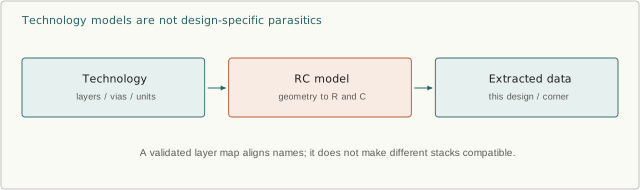
A router must know what routing layers exist and how legal connections can move between them. A placer needs a legal placement grid compatible with the cells. Coordinates need a scale, and cell dimensions must agree with that scale. Without consistent technology data, a netlist can be logically sensible while its physical implementation is impossible or incorrectly sized. ICC2 can load technology data when creating a design library, using a technology file or a technology-library reference. In the supplied Data Model guide, a loaded technology file's data is stored in the library, so retaining the external source file is mainly important for traceability and updates after import. Report what is actually loaded instead of assuming an edited file has automatically changed the database. The implementation technology file is not a substitute for every foundry verification deck. Detailed signoff DRC, LVS, extraction, antenna, or reliability checks may need separate qualified inputs. Likewise, layer definitions alone are not a complete interconnect delay model; RC technology is a distinct part of the setup.
Common Mistake
Saying the technology file contains all standard-cell timing arcs, or that passing implementation rules automatically proves signoff DRC cleanliness.
Follow-up Question & Model Response
Is changing only the layer names enough to move to a different metal stack? No; geometry rules, via definitions, RC models, and library compatibility also matter.
Practical Example
If the netlist's reference cells use one database scale but the design library expects another, physical dimensions may be incompatible even though cell names match. Check the scale, sites, and stack together.
Continue practising