What do routing-track pitch and offset mean?
From PDVerse PnR Interview Handbook · pdVerse Mentor Guide
Short Answer
Track pitch sets the distance between candidate routing centerlines. Track offset sets where the first centerline begins relative to the coordinate origin used by the track definition. Both are needed to locate a track.
Technical Explanation
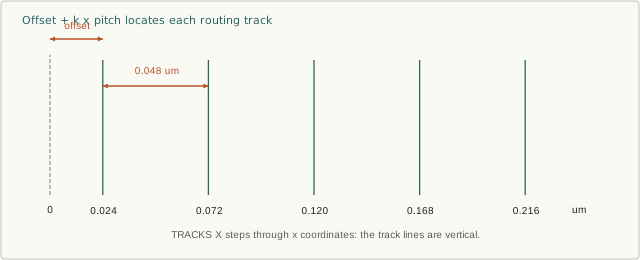
A simple regularly spaced grid can be written as coordinate = offset + k times pitch, where k is an integer within the track count. With an offset of 0.024 um and a pitch of 0.048 um, the first five coordinates are 0.024, 0.072, 0.120, 0.168, and 0.216 um. A pin centered at 0.100 um is not automatically centered on one of these tracks. In DEF, TRACKS X enumerates x coordinates, which describe vertical track lines. TRACKS Y enumerates y coordinates, which describe horizontal track lines. This often surprises beginners who assume X means a horizontal wire. The coordinate being stepped and the direction of the line are different concepts. A layer's preferred routing direction must be considered separately. Track alignment is only one part of pin access. A pin rectangle may overlap a usable track even if its center is off-track; via size, enclosure, blockages, and allowed access patterns still determine whether the router can connect. Avoid moving a macro purely to align one pin without checking all of its pins, legal placement grids, and nearby routing resources.
Common Mistake
Reading STEP as edge-to-edge spacing, or forgetting that an otherwise correct pitch can have the wrong offset.
Follow-up Question & Model Response
Why can matching pitch still leave two grids misaligned? Their offsets may differ by a value that is not an integer multiple of the pitch.
Practical Example
A DEF using 2000 DBU/um can encode the example as TRACKS X 48 DO 5 STEP 96 LAYER M2. The starting x coordinate is 48/2000 = 0.024 um, and the step is 96/2000 = 0.048 um.
Continue practising